

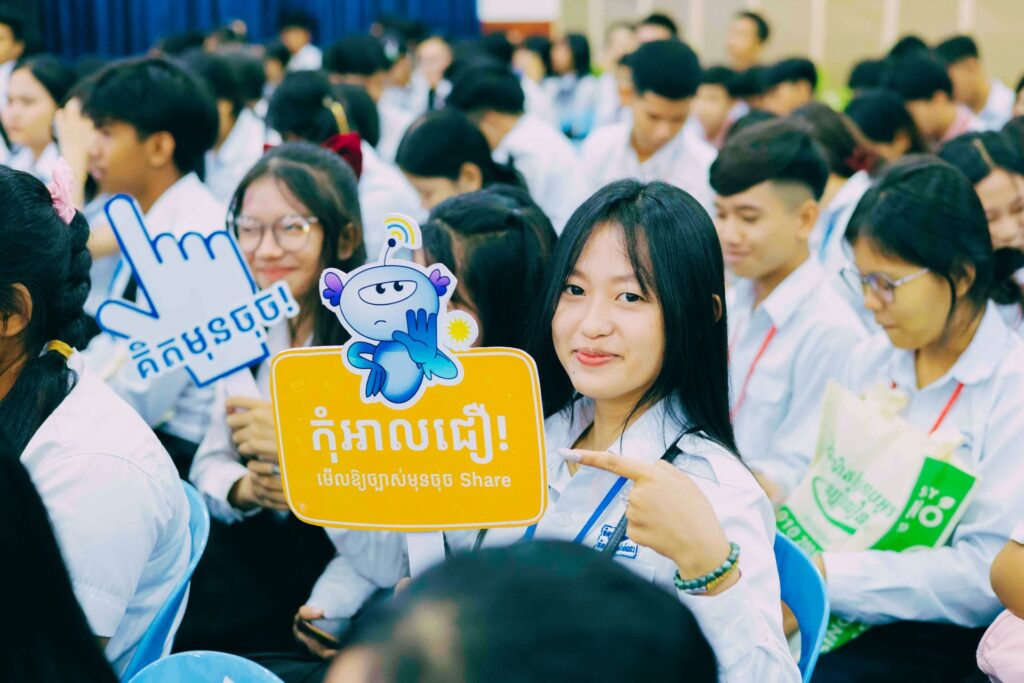
On Tuesday morning of Feb 17, 2026, in Phnom Penh, more than 2,000 people, including children, parents, teachers, government officials, and technology leaders, gathered at the Royal University of Agriculture with a shared mission to make Cambodia’s digital future safer for every child.
A National Commitment to Digital Safety
Safer Internet Day 2026 wasn’t just another campaign. It was a powerful statement of Cambodia’s commitment to protecting its youngest digital citizens. Under the theme “Safe, Ethical, and Responsible Use of Artificial Intelligence (AI),” the event brought together voices from every corner of society, such as government ministers, school principals, tech industry leaders, NGO representatives, and most importantly, the young people whose digital wellbeing is at the heart of this movement.
Deputy Prime Minister and Interior Minister H.E. Sar Sokha, who presided over the event, set the tone for the day’s discussions, emphasizing that digital safety isn’t just a technical issue. It’s a human one that requires everyone’s participation.
Why This Matters Now
Today’s children are growing up in a world their parents never experienced. Artificial intelligence can create videos and images that look startlingly real. Social media connects them to millions. Digital tools open doors to incredible opportunities, but also to new risks.
According to the Internet Watch Foundation, AI-powered technologies are increasingly being misused to create harmful content, including Deepfakes and misleading information targeting young people. Cambodia, like countries worldwide, is confronting these challenges head-on.
The campaign’s approach is built on a powerful framework that positions children not as passive recipients of protection, but as active participants in their digital safety:
EDUCATE: Help children, parents, and teachers understand both the opportunities and risks of AI and digital technology. Knowledge is the first line of defense.
EQUIP: Provide practical tools for safe online behavior, critical thinking, and responsible digital citizenship. It’s not enough to warn—we must teach.
EMPOWER: Build confidence in young people to speak up, seek help, and become leaders in their online communities. They are partners, not just those we protect.
Voices from the Front Lines
The day’s most powerful moments came not from speeches, but from conversations between parents and children, teachers and students, policymakers and activists.
“Today, young people are not merely beneficiaries of this campaign. You are active partners and future leaders for digital safety. The digital world offers unprecedented opportunities, but alongside these opportunities, internet technology also presents risks that demand careful attention.”
— Mr. Samleang Seila, Executive Director, APLE Cambodia
“Internet users, especially children and youth, must be empowered to keep themselves and others safe online. We encourage all stakeholders to participate in education and awareness-raising in schools and communities.”
— H.E. Sar Sokha, Deputy Prime Minister
Part of a Global Movement
Cambodia didn’t stand alone. Across 160+ countries worldwide, communities gathered for Safer Internet Day, a movement that began in Europe in 2004 and has grown into one of the world’s most significant child protection initiatives.
Since 2019, APLE Cambodia, with support from the Royal Government of Cambodia, has organized this campaign annually, each year expanding its reach and deepening its impact. This year’s event marked the most ambitious effort yet, with activities spanning three locations: Kratie, Kampong Cham, and Phnom Penh.
A Coalition for Children
The success of Safer Internet Day 2026 reflects the power of partnership. The campaign was jointly organized by the National Committee for Counter Trafficking (NCCT) and APLE Cambodia, with collaboration from:
• Ministry of Education, Youth and Sport
• National Council for Children
• Ministry of Posts and Telecommunications
• Ministry of Agriculture, Forestry and Fisheries
• Ministry of Information
• Union of Youth Federations of Cambodia
Financial support came from CBRD Fund, Smart Axiata, Mission Alliance, Bread for the World, ChildFund Cambodia, Hagar, AusCam, Marici, and Mlop Tapang, demonstrating that protecting children online requires commitment across all sectors.
What Comes Next
The conversations started on February 10 continue in homes, schools, and communities across Cambodia. Because digital safety isn’t built in a day. It’s built through sustained commitment, open dialogue, and the recognition that in our increasingly connected world, every child deserves to explore, learn, and grow online with confidence and security.